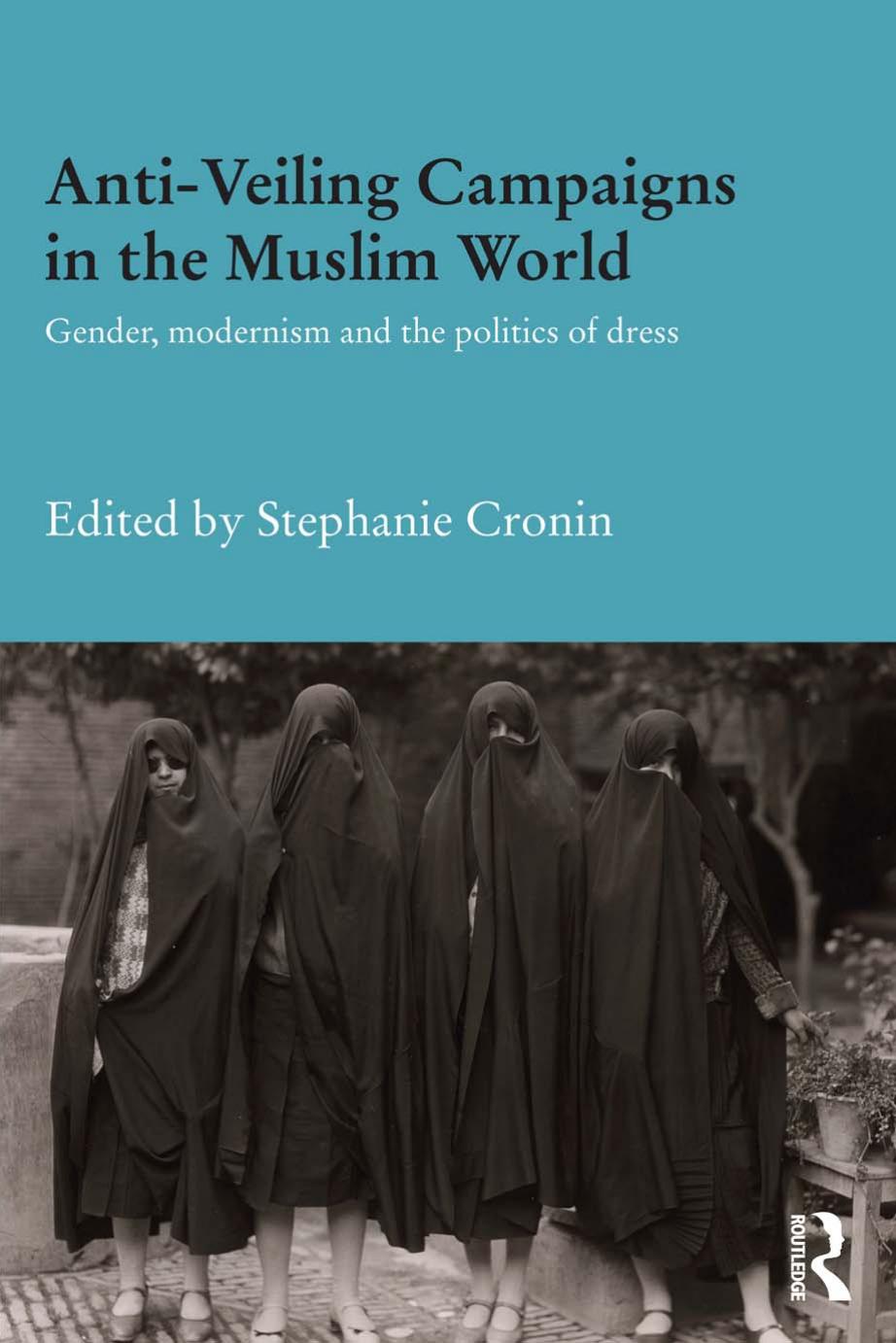
Anti-veiling Campaigns in the Muslim World by Cronin Stephanie
Author:Cronin, Stephanie.
Language: eng
Format: epub, pdf
ISBN: 9781134653058
Publisher: Taylor & Francis (CAM)
Conclusion: Reza Shah’s legacy and the modernization of Islamic hijab (1930s–1970s)
In an important sense, Iran’s 1930s kashf-i hijab was an enduring success, surviving the fall not only of Reza Shah but of the Pahlavi dynasty. In fact, what arguably was the core concern of 1930s kashf-i hijab, i.e. the uncovering of women’s faces in public, has remained in effect to the present. This was accepted as Islamic by Reza Shah-era high clerics, as well as the next generation of Iran’s modernizing clerics. The latter were best exemplified by the influential Ayatollah Mortiza Motahhari, whose clear endorsement of Islamic hijab allowing uncovered faces helped pave the way for the adoption of the same practice by the Islamic Republic of Iran. Motahhari’s most direct, detailed, and specific work on this topic is The Question of Hijab (Mas’alih-i hijab), a book based on lectures he delivered to the Islamic Association of Physicians several years before the 1978–79 revolution.60 Superficially engaged with contemporary debates on feminism and women’s rights, Motahhari was apologetic regarding Iranian women’s existing social status and participation in public life. On the other hand, he was quite thorough and in full command of his subject when discussing juridical (fiqhi) matters. Deploying a seemingly secular utilitarian argument, his narrative generally contended that uncontrolled mixing of genders leads to social corruption and women’s sexual objectification and exploitation. Hence, Islam reasonably requires certain limitations on contact between genders in public, including a dress protocol for women.61
Motahhari’s final pronouncement on Islamic hijab, however, was clear and well articulated. First, he noted the original meaning of hijab in Arabic as “curtain” (pardih in Persian), as well as “separation” and/or “covering.” Therefore, hijab referred to dress only in its secondary meaning, for which Motahhari identified a clear technical definition in Islamic jurisprudence (fiqh).62 According to him, there was indisputable fiqhi consensus, among both Sunnis and Shi’i jurists, that women’s face and hands, i.e. the palm and fingers, need not be covered. Therefore, he argued, while traditional Iranian practices such as “face covering” (ru-giriftan) may be customary (urfi), they are not fiqhi. Motahhari’s reasoning therefore was the same as Reza Shah-era directives on kashf-i hijab, drafted by individuals who were equally cognizant of what fiqh had pronounced on the subject.63
Thus, the ultimate irony of kashf-i hijab in twentieth-century Iran is its curious continuity to the present. In other words, the currently mandated hijab under the Islamic Republic of Iran bears more resemblance to Reza Shah-era dress codes than to pre-1930s “traditional” dress styles of Iranian women. Although the chador, the nemesis of the 1930s kashf-i hijab, continues to be worn by many Iranian women, it is in practice going out of style. Despite some early attempts, the chador did not become part of the mandatory dress code in the Islamic Republic, which officially adopted overcoats and various forms of “modern” head covering. Last but not least, the overlap in the appearances of 1930s-era forcibly unveiled Iranian women (uncovered faces, plus coats and hat) and women’s current forced veiling
Download
Anti-veiling Campaigns in the Muslim World by Cronin Stephanie.pdf
This site does not store any files on its server. We only index and link to content provided by other sites. Please contact the content providers to delete copyright contents if any and email us, we'll remove relevant links or contents immediately.
| Anthropology | Archaeology |
| Philosophy | Politics & Government |
| Social Sciences | Sociology |
| Women's Studies |
Cecilia; Or, Memoirs of an Heiress — Volume 1 by Fanny Burney(32558)
The Great Music City by Andrea Baker(32019)
Cecilia; Or, Memoirs of an Heiress — Volume 2 by Fanny Burney(31956)
Cecilia; Or, Memoirs of an Heiress — Volume 3 by Fanny Burney(31942)
We're Going to Need More Wine by Gabrielle Union(19046)
All the Missing Girls by Megan Miranda(16028)
Pimp by Iceberg Slim(14507)
For the Love of Europe by Rick Steves(14121)
Bombshells: Glamour Girls of a Lifetime by Sullivan Steve(14075)
Talking to Strangers by Malcolm Gladwell(13370)
Norse Mythology by Gaiman Neil(13365)
Fifty Shades Freed by E L James(13241)
Mindhunter: Inside the FBI's Elite Serial Crime Unit by John E. Douglas & Mark Olshaker(9343)
Crazy Rich Asians by Kevin Kwan(9292)
The Lost Art of Listening by Michael P. Nichols(7506)
Enlightenment Now: The Case for Reason, Science, Humanism, and Progress by Steven Pinker(7313)
The Four Agreements by Don Miguel Ruiz(6765)
Bad Blood by John Carreyrou(6621)
Weapons of Math Destruction by Cathy O'Neil(6280)
